Unaccompanied alien minors

Our commitment

Con With its commitment to unaccompanied alien minors, Fondazione Cariplo supports the strengthening of their integrationindependence and inclusion in local areas, through interventions aimed at educational and psychosocial care, development of skills and consolidation of local systems.

The Foundation’s action aims to contribute to greater responsiveness from institutions and local communities, by promoting collaboration between public bodies, the Third Sector and philanthropic bodies, and by encouraging the dissemination of shared knowledge and practices on the subject.

Fondazione Cariplo launched the first interventions to support unaccompanied alien minors in 2016, by promoting trials of new approaches to reception and integration, the strengthening and dissemination of best practices for second reception, as well as their monitoring and advocacy activities at national level.

In the following years, taking as a starting point the experience of the national initiative Never Alone, the need emerged to combine the systemic approach with a more direct commitment to local areas, oriented towards the construction of integrated care systems that could overcome the fragmentation of interventions and ensure greater continuity in minors’ pathways.

Based on this evidence, in 2024 Fondazione Cariplo redefined and strengthened its commitment, by adopting a multifaceted approach that combines:

  • initiatives for co-ordination and learning at a national level
  • targeted interventions in urban settings where there are significant numbers of unaccompanied alien minors
  • participatory planning pathways and strengthening of local networks.

The Foundation’s current commitment plays out along through three complementary lines of action, designed to operate on different scales and in an integrated way.

The Foundation’s current commitment plays out along through three complementary lines of action, designed to operate on different scales and in an integrated way.

Never Alone, per un domani possibile è un’iniziativa filantropica di respiro nazionale ed europeo dedicata ai minori stranieri non accompagnati, nata per sostenere il loro benessere, la tutela dei diritti e i percorsi di integrazione e autonomia.

L’iniziativa è stata lanciata nel maggio 2015 in occasione dell’Assemblea generale annuale dello European Foundation Centre (EFC), all’interno dello European Programme for Integration and Migration (EPIM), e ha visto fin dall’inizio la collaborazione di fondazioni italiane ed europee impegnate sui temi della migrazione e dell’inclusione.

In Italia, Never Alone è promossa da un gruppo di fondazioni che include Fondazione Cariplo, insieme a Compagnia di San Paolo, Fondazione Cassa di Risparmio di Cuneo, Fondazione Cassa di Risparmio di Padova e Rovigo, Fondazione Cassa di Risparmio di Torino, Fondazione CON IL SUD, Fondazione Monte dei Paschi di Siena e Fondazione Peppino Vismara. Nel tempo, l’iniziativa ha inoltre beneficiato del contributo di altri soggetti su specifiche linee di intervento.

Le prime fasi dell’iniziativa

Nel corso delle prime due fasi di Never Alone (2016‑2017 e 2018‑2019), le fondazioni promotrici italiane hanno stanziato complessivamente 9,65 milioni di euro, destinati in larga parte a due Bandi nazionali rivolti a organizzazioni del Terzo Settore.

Attraverso questi bandi, Never Alone ha sostenuto interventi orientati a:

  • sperimentare nuovi approcci di accoglienza e integrazione;
  • rafforzare e diffondere buone pratiche di seconda accoglienza;
  • promuovere modelli di presa in carico personalizzati, attenti ai diritti e ai bisogni dei singoli minori;
  • accompagnare i progetti con attività di monitoraggio, valutazione e apprendimento;
  • sviluppare azioni di advocacy e sensibilizzazione a livello nazionale.

In ciascuna delle due edizioni del bando sono stati finanziati otto progetti, realizzati in 12 regioni italiane, che hanno coinvolto oltre 120 enti, tra cui numerosi enti pubblici. Complessivamente, i progetti hanno accompagnato migliaia di minori e giovani stranieri non accompagnati nei loro percorsi verso l’autonomia.

Un approccio sistemico e di lungo periodo

Nel tempo, Never Alone si è caratterizzata come un’esperienza di sistema, capace di andare oltre il finanziamento di singoli interventi, promuovendo:

  • il coordinamento tra attori pubblici e del Terzo Settore;
  • la condivisione di strumenti e metodologie;
  • la costruzione di comunità di pratiche;
  • il rafforzamento del sistema di tutela volontaria, introdotto dalla legge 47/2017;
  • una riflessione comune sulle politiche e sulle prassi di accoglienza e protezione dei minori stranieri non accompagnati.

Questa impostazione ha consentito di capitalizzare le esperienze maturate nei diversi territori e di contribuire a un’evoluzione delle risposte, in un contesto caratterizzato da forti cambiamenti normativi e da un andamento non lineare dei flussi migratori.

Never Alone oggi

Dopo le fasi 2016‑2019, l’iniziativa ha proseguito il proprio percorso attraverso ulteriori sviluppi e integrazioni (2020‑2023), fino ad arrivare alla nuova fase 2024‑2026, che si pone in continuità con quanto realizzato e rafforza ulteriormente:

  • le comunità di pratiche;
  • le azioni di supporto ai tutori volontari;
  • le iniziative di advocacy e comunicazione;
  • la sperimentazione di nuove risposte a livello locale.

Fondazione Cariplo partecipa a Never Alone contribuendo alla definizione della strategia condivisa e sostenendo, in dialogo con gli altri promotori, un’azione filantropica orientata a rafforzare il sistema nel suo insieme e a generare cambiamenti duraturi.

Fr‑Agile! è un progetto volto a rafforzare la capacità di risposta del sistema di accoglienza della città di Milano di fronte alla crescente presenza di minori stranieri non accompagnati con fragilità psicosociali, che richiedono interventi dedicati. Si tratta di giovani che, oltre alle difficoltà legate al percorso migratorio e all’assenza di un riferimento familiare, possono presentare condizioni di disagio emotivo, relazionale o psicologico, per le quali i percorsi di accoglienza tradizionali risultano talvolta non adeguati. Fr‑Agile! interviene quindi per sostenere i minori più fragili e rafforzare il coordinamento tra i servizi coinvolti, favorendo risposte più integrate e coerenti con i bisogni espressi. Il progetto è stato avviato a luglio 2024 e ha una durata triennale.

Cosa fa Fr‑Agile!

Il progetto lavora su più livelli, mettendo al centro i ragazzi e le ragazze e, allo stesso tempo, sostenendo chi ogni giorno si prende cura di loro.

In particolare, il progetto:

  • offre percorsi di accoglienza più flessibili, pensati per i minori che fanno più fatica a stare nei contesti tradizionali;
  • affianca i ragazzi e le ragazze con il supporto di educatori e professionisti, per aiutarli a ritrovare stabilità e continuità;
  • crea spazi educativi e attività diurne dove poter costruire relazioni, sviluppare competenze e sentirsi parte di una comunità;
  • sostiene operatori e operatrici dei servizi attraverso momenti di confronto, formazione e accompagnamento;
  • favorisce il dialogo tra i diversi soggetti coinvolti, per rendere l’accoglienza più coordinata ed efficace.

Il progetto adotta la metodologia CANS (Child and Adolescent Needs and Strengths) come strumento condiviso per la lettura dei bisogni e delle risorse dei minori, a supporto di una presa in carico personalizzata e coordinata tra i servizi coinvolti.

Una rete che lavora insieme

Fr‑Agile! è realizzato grazie alla collaborazione tra enti del Terzo Settore attivi a Milano (cooperative Farsi prossimo, Spazio aperto servizi, Comunità Progetto, Fuori luoghi, Ceasoltreilpregiudizio, Save The Children Italia – ETS e Istituto per la Ricerca Sociale), il Comune di Milano e l’Unità di Neuropsichiatria Infantile del Policlinico, che mette a disposizione competenze specialistiche sul benessere psicologico degli adolescenti.

Il progetto è sostenuto da Fondazione Cariplo, dall’Impresa sociale Con i Bambini e dalla Fondazione Peppino Vismara, che hanno scelto di investire insieme in una sperimentazione pensata per rafforzare il sistema cittadino di accoglienza.

SISTEMI TERRITORIALI PER L’ACCOGLIENZA E L’AUTONOMIA DEI MINORI STRANIERI NON ACCOMPAGNATI

Questa linea di intervento nasce dalla consapevolezza che l’aumento del numero di minori stranieri non accompagnati sta mettendo sotto pressione, in molti territori, la capacità dei servizi di garantire percorsi di accoglienza e accompagnamento adeguati e continuativi. In risposta a questa situazione, Fondazione Cariplo promuove la costruzione e il rafforzamento di sistemi territoriali in grado di offrire risposte più coordinate, stabili e coerenti lungo l’intero percorso dei minori, dall’accoglienza all’autonomia. L’obiettivo non è sostenere singoli servizi o interventi isolati, ma favorire una visione condivisa a livello provinciale, capace di mettere in rete soggetti pubblici e privati e di migliorare il funzionamento complessivo dei sistemi di presa in carico.

Un lavoro costruito insieme ai territori

Nel 2025, in collaborazione con le Fondazioni di Comunità, Fondazione Cariplo ha accompagnato percorsi di progettazione partecipata nelle province di Bergamo, Brescia, Cremona, Pavia, Lecco, Monza e Brianza.

I percorsi hanno coinvolto enti pubblici, organizzazioni del Terzo Settore e altri attori rilevanti a livello locale, con l’obiettivo di:

  • analizzare i bisogni specifici dei territori;
  • valorizzare le risorse già presenti;
  • individuare priorità condivise di intervento;
  • costruire progettazioni capaci di rafforzare le reti esistenti e migliorarne il coordinamento.

I progetti

A esito di questi percorsi, sono stati deliberati cinque progetti di durata pluriennale, il cui avvio è previsto tra la fine del 2025 e l’inizio del 2026.

I progetti sono orientati a:

  • migliorare la continuità dei percorsi di accoglienza;
  • rafforzare il raccordo tra servizi educativi, sociali, sanitari e per l’inserimento lavorativo;
  • accompagnare i minori e i neomaggiorenni verso una maggiore autonomia;
  • sostenere la capacità dei territori di rispondere in modo strutturato a bisogni complessi e in evoluzione.

Accompagnamento, monitoraggio e apprendimento

I percorsi di progettazione e di avvio degli spiegati interventi sono accompagnati da Codici Ricerca e Intervento, che supporta il monitoraggio e la valutazione dei progetti, la raccolta e la lettura dei dati, la creazione di una Comunità di Pratiche, pensata come spazio di confronto e scambio tra i territori coinvolti.

Questa dimensione di accompagnamento è parte integrante dell’intervento e mira a favorire l’apprendimento condiviso e il miglioramento continuo delle pratiche.

Prospettive

Nel corso del 2026 è previsto l’avvio di nuovi percorsi di progettazione anche in altri territori lombardi, con l’obiettivo di estendere progressivamente l’approccio e rafforzare la capacità complessiva dei sistemi territoriali di accoglienza e accompagnamento dei minori stranieri non accompagnati.

Photo credits © “All rights reserved”
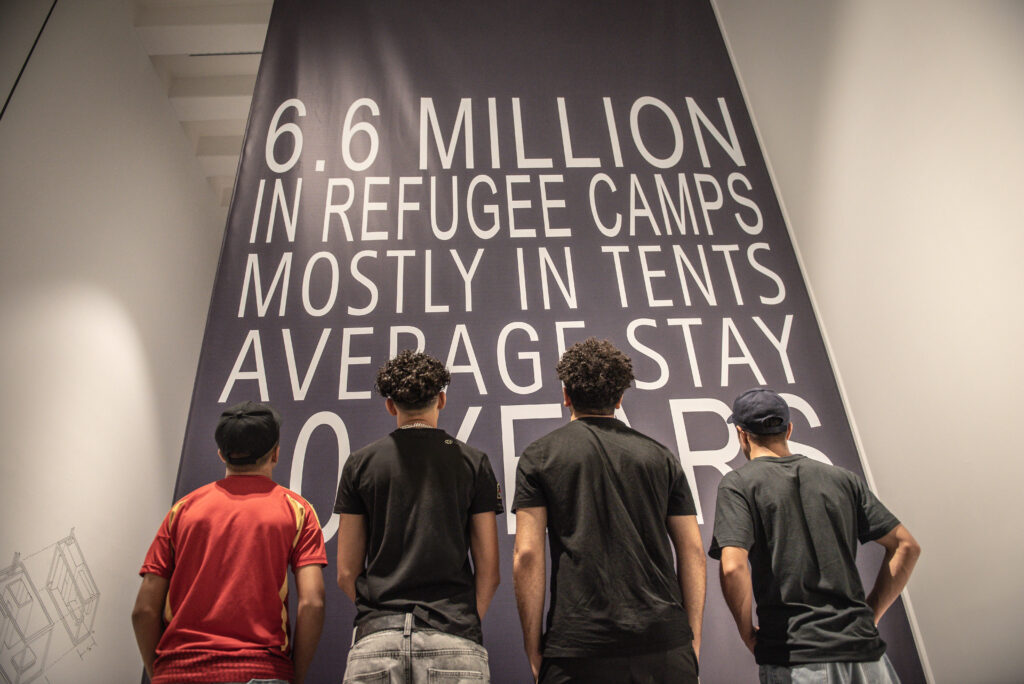
We would like to thank the participants in the collective that produced the “Milan seen from the sea” exhibition as part of the Fr-Agile! project. Places, links, connections for the inclusion of unaccompanied alien minors with vulnerabilities: Azer Ajili, Moaz Emad Hamdy, Abdelhameed Abdelmaksoud, Basem Ezzat Tamer Eskarous, Eslam Abdelwahad Salah, Abdelwahad Youssef, Azimi Khalmirza, Chiara Azzollini, Aldayeb Hamed Ali, Fernanda Aires, Roberto R. Franchi

Welfare in action

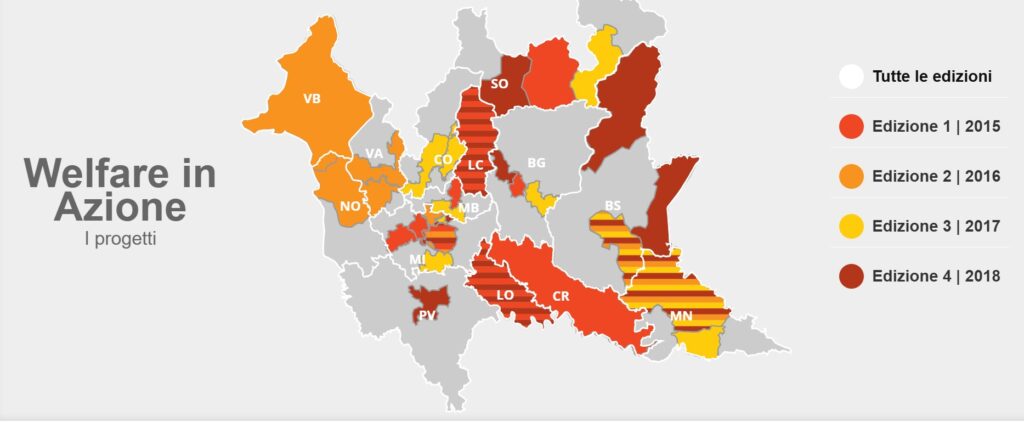
With the Welfare in Action programme, launched in 2014, Fondazione Cariplo has experimented with new forms of local welfare based on the strengthening of the community dimension and therefore on the engagement of society and citizens in participatory processes to respond more effectively and efficiently to existing and emerging social needs. 

Thirty-seven projects, currently all completed, have been supported in the four editions of the call for proposals, with a total of 352 public and private social partners involved (as well as hundreds of other entities in the connected networks), €36.5 million of grants approved against a total cost of €82.7 million.

In line with the methodological choice of leaving the identification of the issue for focus to the project networks, in recent years a cross-sectoral process of rethinking local welfare in many funded areas has been launched in the communities. Many topics have been addressed with transformation and innovation in mind: from vulnerability to care and conciliation services, from local policies for young people to how to meet the needs of people with disabilities, from mental health and corporate welfare with connections to local care services to the widespread integration of asylum seekers and restorative justice. The projects were supported at various stages in their monitoringcommunication and fundraising activities, including by encouraging practical meetings in the community, as well as encounters and in-depth analysis.

The project and the various actions supported have been reported in articles on the website WelfareinAction and at several public events, including ones held on 22 September 2017 at the Teatro Elfo Puccini and on 28 March 2019 at the Palazzo delle Stelline. Fondazione Cariplo also believes in the importance of conducting in-depth analyses of the learning and outcomes arising from the projects, made possible by the collaboration of research institutions, resulting in publications and articles on relevant websites.      

Link for further information

AttivAree

60% of the Italian territory consists of smaller, often very small towns and villages. The reasons are mainly due to the specific topography of the land, but also to history, resulting over time in complex settlement dynamics. 
For the most part, these centres are distant from urban areas, nestled among mountain reliefs or spread off the plains: places that once, when people lived almost exclusively on agriculture, were flourishing and populated, but which with the reversal of the economic situation have begun to undergo progressive depopulation. People have begun to migrate towards cities in search of more viable and comfortable work and life opportunities. 

The abandonment was slow and inexorable, initially affecting the most isolated hamlets, followed by villages and finally entire areas: the marginal areas. Distant lands, both geographically (because they are far from the most heavily developed urban centres and organised in terms of services and opportunities) and from a cultural point of view, due to their ‘distance’ from a social evolution that has radically changed people’s needs. 

These were times of transition conditioned by an economic recovery that seemed unstoppable and which took people to the cities, where a better life was on the cards, far from rhythms dictated by nature, “calluses on the hands” and the “phases of the Moon”. 

All this, however, has now changed and a new phase has begun. Within a couple of generations, a new awareness of the relationship with the land has arisen, and people learned in technology and knowledge that makes the difference return (backwards) to tread in the footsteps of their forerunners who started off in the same places… 

In rural areas and villages scattered throughout Italy, the spotlight and hope have now been re-ignited. There is a renewed focus on these locations as ideal bastions that have preserved our history, representing – with their unique environmental, cultural and social attractions – an important part of our heritage
A market now also exists, with promise and preparedness to leverage this heritage, which must therefore be systematised and looked at in a new way, to transform what was once a reason for abandonment into a resource and to transform what has been handed down and has remained in people’s experience

This look at the unexpressed potential of these areas has encouraged Fondazione Cariplo to promote AttivAree, the cross-sectoral program that aims to reactivate marginal areas in the Foundation’s catchment area and increase their appeal towards residents, potential investors and the relevant urban hubs, by leveraging the resources of the communities. 

Objectives  

The watchword is regeneration of local areas through a process of change that favours social, cultural and economic growth, to be achieved by: 

  • encouraging participatory processes 
  • enhancing the role and skills of the third sector 
  • adopting cross-sectoral approaches that integrate environmental, social, cultural, economic and research opportunities 
  • developing fruitful interactions between inland and urban areas 
  • reusing existing buildings that do not involve further land consumption. 

 Local areas  

The AttivAree programme is funding two projects for the “renaissance” of inland areas selected based on the project ideas submitted by 11 local areas in Lombardy and Verbano-Cusio-Ossola during the call for proposals phase that ended on 30 June 2016. The projects, which cover the inland areas of the Oltrepò Pavese and the Trompia and Sabbia valleys in Brescia province, have grasped the idea of the development and structured consolidation of an imaginary bridge to the city and the larger urban centres, not in terms of subordination or loss of identity but of complementarity and exchange of know-how and services. Likewise, they have shared a reinterpretation of the role of agriculture in more modern environmental, social and scientific terms

Projects 

Nel  progetto Oltrepò(BIO)diverso, promosso dalla Fondazione Sviluppo Oltrepò Pavese, si punta  sulla biodiversità come fattore di competitività, connessione, sviluppo e ripopolamento, un  progetto che si può definire di “rigenerazione rurale e comunitaria”. La biodiversità è intesa anche in senso sociale, culturale e interculturale, attribuendo un rinnovato ruolo all’agricoltura e al paesaggio anche come ambiti di applicazione di ricerca scientifica. L’accesso alla terra è un elemento fondamentale per promuovere l’attività agricola multifunzionale e per questo si intende lavorare per il superamento della frammentazione fondiaria e per la valorizzazione del patrimonio di biodiversità (ad esempio, la ricchezza di specie di farfalle presenti in Oltrepò è  pari a quella dell’intera Gran Bretagna). Collegata a questa visione, è l’idea di aprire la comunità locale a giovani e migranti e di sviluppare nuovi servizi che favoriscano il ripopolamento rurale e la conciliazione lavoro-famiglie e quindi una maggiore occupazione femminile, nonché la riattivazione di luoghi che rafforzi il processo di identità culturale collettiva. 

Nel progetto “Valli Resilienti”, proposto dalle Comunità Montane di Valle Trompia e Valle Sabbia, l’idea di rilancio è basata su una strategia articolata su diversi ambiti tematici, che punta a valorizzare le esperienze e competenze del territorio, insieme alle opportunità offerte dalle nuove tecnologie. Vi è inoltre un buon equilibrio tra il “dentro” e il “fuori”: da un lato servizi di prossimità agli abitanti gestiti in rete attraverso cooperative sociali e azioni di valorizzazione di prodotti locali, dall’altro efficienza amministrativa per attrarre nuovi investitori o accoglienza specializzata per target sociali fragili provenienti anche da altri territori. La leva che si intende utilizzare si basa sulla volontà di collaborazione e reciproca contaminazione tra i partner, scambiandosi buone pratiche e replicando quelle che funzionano. 

InnovaWelfare

In 2023, the Foundation launched the InnovaWelfare project, with the aim of enhancing the innovation capacity of non-profit entities working in the welfare system to improve responses to needs in the short and medium to long term. The Project is jointly promoted by the Social & Human Services Area and theScientific Research Area, together with Cariplo Factory srl benefit company and the Giordano dell’Amore Social Venture Foundation. It works according to three axes:  

  • Technological Observatory
  • the InnovaWelfare Call for Proposals to support non-profit organisations in trialling innovative solutions enabled by technology and/or digital
  • Impact Investing activities to provide further support for the best solutions tested in the Call for Proposals.

As part of the Observatory, theUniversity of Bergamo has conducted a study that outlined the opportunities offered by technology and digital technology in innovating in welfare services in the light of the social transformations underway. In the first two Calls for Proposals, 17 projects were supported to implement pilots and trials of technological solutions for the improvement of welfare services. Any investment in the best solutions supported by the call is currently under evaluation.

Based on the results of the actions carried out, the Foundation is working on an evolution of the Call for Proposals to continue to support non-profit organisations that intend to improve their welfare services through new technologies.

Housing Sociale

Since 1999, Fondazione Cariplo has tackled the issue of social housing with determination, launching several calls for proposals aimed at increasing the offering, through non-profit providers, of housing and support services for people with a wide range of vulnerabilities. Since 2011, these have merged into a single call for proposals, “Social housing for the vulnerable”, which stimulates local areas to increase their ability to respond to certain housing needs (relating to socio-economic circumstances, disability and ageing). The aim is to enhance the offering and strengthen people’s independence, by maximising the affordability of housing solutions. To date (December 2025), the Foundation has supported 424 projects by approving grants of over €80 million, providing approximately 7,000 beds for vulnerable people.

Plus, since 2004, Fondazione Cariplo has decided to systematically address the issue of private social housing; it has done so with the participation and support of the Lombardy Region and ANCI Lombardy by establishing a purpose-based foundation. The Social Housing Foundation currently actively promotes the social housing model in Italy, as an advisor to funds that invest in the sector; it provides assistance in the design of interventions, offering advice in urban and architectural planning, in the design of services and housing welfare and in community development. 

SHF’s commitment led in 2006 to the creation of the first Italian fund focusing on social housing – the Fondo Abitare Sociale 1 – which served as the basis for the subsequent establishment of the Fondo Nazionale Investimenti per l’Abitare, managed by the Integrated System of Social Housing Funds (SIF), which carries out social housing projects throughout Italy. The SIF is now one of the largest impact investment programmes worldwide.   

The experience of social housing has experienced its greatest level of development in the Lombardy Region. In 2019, REDO Sgr S.p.A.– Benefit Company took over management of the Fondo Abitare Sociale 1 (now known as the Fondo Immobiliare di Lombardia – FIL). REDO also focuses its attention and expertise on student housing and urban regeneration. 


Innovation for Development

Innovation for Development is a programme led by Fondazione Cariplo together with Fondazione Compagnia di San Paolo, aimed at supporting innovation in the field of international co-operation towards development, focusing in particular on strengthening ties between Italy and Africa

Active since 2016, the programme’s activities have been structured along three working axes:

  • calls for proposals and opportunities for collaboration between civil society organisations (CSOs) active in international co-operation and the world of Italian and African innovation
  • training of human capital and creation of a community of practice with hybrid skills aimed at practitioners of international development co-operation
  • events and meetings – digital and face-to-face – to encourage networking and continuous exchange of best practices


Project pathway and results

From 2016 to 2023, Innovation for Development supported 59 open innovation projects, reaching about 40,000 direct beneficiaries and 600,000 indirect beneficiaries, involving civil society organisations, innovators and local communities and institutions in both Italy and Africa. In the same period, the programme promoted 26 training and capacity-building courses organised by 17 technical partners. These focused on innovation topics (data for development, entrepreneurial approach and leadership, project management, impact), for which there were a total of 2,200 applications and approximately 1,400 participants.

The events served as opportunities for meeting and networking for the Innovation for Development community, in which 10,000 people were involved in 2023. Over three editions (2017, 2019, 2023), the Innovation Open Days brought together around 1,500 people, in person and in hybrid mode, whereas the Innovation Open Talks webinar series, created to run during the pandemic, reached 600 participants


Consolidation


In 2024, the programme entered its consolidation phase with Innovation for Development – Next, focused on follow-up of projects funded with open innovation calls for proposals on the set-up of a legacy project to make available all learning materials and innovations produced (the website has become a multimedia consultation portal), including for training purposes. As part of the latter, support was provided for the 2024 Social Enterprise Open Camp (Catania, October 2024), led by Fondazione Opes-Lcef and CGM Consortium; the Low Code Academy of Impact Skills with CISV; the GET DATA! (data collection and management) course run by Gnucoop and Soleterre; the digital volunteering initiative led by the Digital for Humanity association. 

Never Alone


Project introduction 

The Never Alone project began in 2015 at the Annual General Assembly of the European Foundation Centre (EFC) in Milan, with the aim of supporting unaccompanied alien minors (UAMs) and young adults in Italy and Europe. The initiative, initially part of the European Programme for Integration and Migration (EPIM), has witnessed the collaboration of various Italian and European foundations to promote the well-being and social inclusion of young migrants. 

In Italy, the project is led by Fondazione Cariplo together with Fondazione Compagnia di San Paolo, Fondazione Cassa di Risparmio di Cuneo, Fondazione Cassa di Risparmio di Padova e Rovigo, Fondazione Cassa di Risparmio di Torino, Fondazione CON IL SUD, Fondazione Monte dei Paschi di Siena and Fondazione Peppino Vismara. Fondazione Enel Cuore and JP Morgan also contributed on specific topics. 


Previous project phases 


Phases 1 & 2 (2016-2019)

With a total investment of €9,650,000, the project has made it possible to launch two national calls for proposals aimed at innovation in care for UAMs, by promoting integration and independence while respecting the children’s rights. In the two editions, 16 projects were funded in 12 Italian regions, involving over 120 institutions (at least 20 of which are public) and supporting over 4,000 young migrants

During phase 2, the voluntary protection system (Law 47/2017) was strengthened, with three experimental projects to support voluntary guardians in Piedmont, Tuscany and Sicily and the national project “Pass4You” – to support guardians in accessing embassies to obtain a passport for the UAM, an essential document for conversion of a children’s residence permit. 

A training action was also carried out to encourage a more inclusive narrative on the topic of migration, using materials from the International Centre for Policy and Advocacy (ICPA) in Berlin.


Phase 3 (2021-2022)

With €1,855,000 of resources available, the focus remained on the transition to adulthood and independence. In conjunction with the social enterprise Con i Bambini, the “For a possible tomorrowcall for proposals was promoted, in continuity with the Never Alone experience.  

Through the “Constellations” project, a community of practice has been developed around the transition to adulthood, planned and implemented to capitalise on the experiences gained since the initiative began and to strengthen the subjects by sharing of best practices relating to three axes: workhousing and social relations
The “Guardians Network” project was also launched, which led to the creation of a second-level national association of volunteer legal guardians. The dissemination of the ICPA narrative kit and the training of a team of trainers with specific skills continued. 


Current phase (since 2024) 

In June 2024, approval was given for phase 4 of the project, which includes interventions in five strategic areas.

  • Transition to adulthood: continuation of the community of practice on the three axes of intervention previously identified – work, housing and social relations – and on a further focus relating to language learning and training.
  • Support for the voluntary guardianship system: extension to national level of support activities for voluntary guardians and experimentation with mentoring.
  • Reception: actions aimed at strengthening the capacity of local areas to welcome minors in a structural way, including by trialling contingency plans and strengthening forms of widespread reception.
  • Protection: actions aimed at preventing situations of violence, abuse and unaccompanied alien minors becoming involved in illegal activities.
  • Development of experimental actions at local level. 

NEETwork

NEETwork is a Fondazione Cariplo project that took place between 2016 and 2023 to support the most vulnerable NEETs, i.e. young people not in education or employment.  

It is an extremely heterogeneous group in terms of age, training and family background, of which a significant proportion has a profile of greater vulnerability, characterised by low levels of educationlacking family and social networks and migration histories that expose them to a greater risk of exclusion and distance from the labour market. 

The project took place in two phases, the first between 2016 and 2019 and the second between 2021 and 2023; the latter was initially characterised by repeated openings and closures due to the pandemic and at the same time by the importance of attempting to support the most vulnerable young people despite the uncertainty of the time. In two editions, the project was configured as summarised below. 

Objective

To reactivate the most vulnerable NEETs via a pathway to reintegrate them into the labour market, consisting of a complementary and integrable ‘package of opportunities’ made up of:

  • strengthening and orientation
  • training in the digital field
  • six-month paid internships in third-sector organisations or companies.


Beneficiaries


NEETs aged 18-24 resident in Lombardy, holding at most a middle school diplomaunemployed for at least three months, not registered with the Youth Guarantee. 


Methods of intervention

Interception of young people falling within the category of beneficiaries, mainly by means of campaigns on the main social media channels (Facebook, Instagram, TikTok, etc.), on the project website, through reporting by employment agencies partnering the project and job centres that were willing to collaborate. Once the requirements had been verified, the young people were contacted to present them with the possible opportunities, set up two cognitive interviews with the accredited body to understand their interests and skills, to identify the most suitable pathway among those offered, as well as theinternship opportunity best suited to their profile from the ones available.

The intervention also included two interviews with an occupational psychologist; one on entry entrance to get to know the young person, understand the reasons for their inactivity/unemployment and discover any vulnerabilities to be taken into account during activation; another as part of the pathway to check/reinforce their motivation to continue. 

The project made use of the valuable collaboration of Lombardy Third-Sector Entities (TSEs), which provided paid internship positions to the young people involved in the project, supported the activation process and offered them a motivational and job education experience.


Operational and institutional partners


Led by Fondazione Cariplo, the project was carried out in partnership with Mestieri Lombardiathe Adecco Foundation and the Toniolo Institute, in conjunction with the Lombardy Region

Results

378 participating third-sector organisations, 776 internship positions282 young people worked with. 

Principali apprendimenti

  1. Complexity of intercepting and engaging NEETs with the project profile, given the young people’s distance from the education system and labour market. Even if they have left their telephone number or e-mail address, they are often unreachable either because they have changed their number or do not answer or read the e-mail. Establishing initial via WhatsApp messaging increases the chances of feedback.
  2. Effectiveness of social media channels in intercepting young people other than those who visit job centres or employment agencies, although it should be noted that social media channels evolve rapidly and require maintenance and updating. Young people found via social media have higher eligibility and activation rates than those who take a CV to a job centre and are comparable to those who have been recommended to the project by an educator or someone else in a relevant position.
  3. High levels of vulnerability Most of the young people encountered have experienced difficulties in their education and lives, have lacked family support; their soft skills tend to be lower than average, alongside issues with relationships and communication. In most cases, they are unstable young people whose minds change quickly; in some cases, they have a fair ability to find work although these are often fixed-term assignments (short-term or illegally).
  4. Once a training pathway has been found and started, the young people have demonstrated good motivation, shown by their desire to acquire new skills, to extricate themselves from inactivity and to achieve economic independence. 

As part of the NEETwork Project, in 2023 the Foundation also promoted the “NEETwork in rete” call for proposals, whereby it funded 11 projects aimed at intercepting, supporting and activating NEETs, including young people meeting the conditions for vulnerability. The projects did so by promoting and strengthening multi-stakeholder networks that included at least one third-sector organisation and a body accredited in employment services. 

Taking as a starting point the experience gained, in 2025 the Foundation decided to further strengthen its commitment to the issue of NEETs, by promoting the ZeroNEET mandate challenge, in conjunction with the Lombardy Region and Intesa Sanpaolo

A unique partnership of Foundations working towards development in Africa


The first two five-year and multi-sectoral initiatives, supported by the system of Italian banking foundations (four to begin with: Fondazione Cariplo, Compagnia di San Paolo, Fondazione Monte dei Paschi di Siena and Fondazione Cariparma) together with Fondazione Umano Progresso and Fondazione De Agostini, were carried out in Senegal and northern Uganda between 2008 and 2013, by a broad partnership consisting of civil society organisations, diaspora associations (for Senegal), local authorities and grassroots associations in the relevant countries. 

Total allocation: approximately €11 million.  

Between 2014 and 2019, the Foundations 4 Africa Burkina Faso Project took place, supported by 25 Foundations in the ACRI ‘system’, implemented in the field by civil society organisations (Acra, CISV, LVIA and MANI TESE Association), a study centre (CESPI), the Slow Food Foundation for Biodiversity, 27 associations of the Burkinabé diaspora spread throughout Italy, and two other diaspora associations active in Burkina Faso. 

Total allocation: approximately €6.3 million

The project focused on ensuring food security and sovereignty for 10,200 small agricultural producers and their families (about 60,000 people), in seven rural regions in Italy. It worked throughout the value chain of the main agricultural and non-forest product supply chains to improve productivity and product quality, strengthen the capacity of 350 farmers’ organisations, doing so by trialling innovative microfinance tools and inclusive financial services, by structuring a marketing system to increase sales on the local market, by promoting the dissemination of adequate food education and by encouraging a leading role for women in organisational structures.  

TOP – Tutoring Online Program

TOP – Tutoring Online Programme is an innovative online study support project, trialled starting in 2020 based on an idea at Bocconi and Harvard Universities, aimed at bridging the widening educational poverty aggravated by the Covid-19 pandemic. Educational poverty, i.e. the condition whereby a student is not guaranteed the right to learn, train, acquire skills and cultivate their passions and abilities, particularly affects the most vulnerable children, from families with economic and social difficulties, but also affects those with cognitive and behavioural difficulties or emotional and interpersonal problems. 

In 2021, as part of its Social & Human Services Area, Fondazione Cariplo decided to invest in the programme to consolidate its model and increase its impact on its catchment area, entrusting its operational management to CIAI (Italian Centre for Child Aid) and continuing the collaboration with the founding universities. 

TOP is aimed at middle school leavers in the Lombardy Region and offers them the support of volunteer university students from Lombardy universities. The participating schools refer students based on their need for school support, but also on other characteristics such as the ability to recognise their educational needs and the desire to address them. The tutors are volunteer university students, who receive training on pedagogical principles and tutoring methodologies, conducted by Bicocca University, as well as on the Child Protection Policy – CPP, consisting of guidelines to be followed in relations with children, edited by CIAI. 

Tutors (volunteer university students) and tutees (middle school students) are paired based on certain characteristics, including language skills, tutoring experience, academic course, time availability, subjects in which support is requested or offered and any previous training in the field of Special Educational Needs and Disabilities (SEND). The choice of a peer learning approach, which links up people relatively close to each other in age and experience, aims to encourage an exchange and discussion that is as equal as possible. 

Tutoring takes place entirely online over the Tutornow platform. Tutors and tutees also have a supervisor as a point of reference, who contacts them to support the tutoring process and encourage dialogue with the school and the tutee’s family. For students who need it, TOP provides refurbished devices and an internet connection, made possible by an agreement with TechSoup Italia

The results of the mentoring programme have been recorded via an impact assessment according to the counterfactual approach, conducted by Bocconi University. The analyses of previous editions showed that participation in TOP had a positive influence not only on academic performance (three months of tutoring is equivalent to approximately nine months of classroom learning), but also on educational aspirations and the children’s psychological and socio-emotional well-being. In light of the programme’s results, especially in terms of the beneficiaries’ academic performance, from 2025 the TOP programme formed part of the prevention activities of the ZeroNEET mandate challenge, under the Cross-sectoral Philanthropic Activities & Mandate Challenges Area. 

Institutional partners

  • Fondazione Cariplo: the programme promoter and funder, it supervises the entire process and relations with the parties involved. 
  • CIAI (Italian Centre for Child Aid): implementing partner of the programme, responsible for operational management. As part of TOP, it is responsible for recruiting and training supervisors to work with tutors, providing training on the Child Protection Policy and controlling its application, maintaining relations with schools and technical partners, and monitoring project progress by keeping in regular contact with the team. 
  • Bocconi University: programme creator and scientific partner, responsible for impact assessment, in conjunction with Harvard University. It is responsible for attracting applications from middle schools and tutors, for matching tutors and tutees using an algorithm that pairs their characteristics, and for administration of evaluation questionnaires to all the parties involved, to carry out the impact assessment. 
  • Bicocca University, Milan: responsible for tutors’ pedagogical and methodological training. It is responsible for training both tutors and supervisors, organises supervision meetings for tutors, and assesses the impact of the chosen tutoring model on the tutors’ skills development. 

Technical partners

  • Tutornow: the platform on which all TOP activities take place. It ensures a safe environment and provides tools for running lessons. 
  • TechSoup: an international non-profit organisation, providing technological solutions to the third sector. As part of TOP, it is responsible for reconditioning devices and distributing them to students who request them. 

Lombardy universities in conjunction with TOP for volunteer tutors

  • IULM 
  • Polytechnic University of Milan 
  • Bocconi University 
  • Carlo Cattaneo University – LIUC 
  • Università Cattolica del Sacro Cuore 
  • University of Insubria 
  • University of Bergamo 
  • University of Brescia 
  • Bicocca University, Milan 
  • University of Pavia 
  • Università Vita-Salute San Raffaele